Botox vs face tightening: Solving the "sad face" and sagging jowls

At a glance: Botox vs Face Tightening
Botox and face tightening treatments are often grouped together, but they address different aspects of facial ageing.
|
In this article
If you have noticed your mouth corners pointing downward, your jawline softening, or your cheeks looking flatter than they used to, you are not alone. These changes are incredibly common, and they are the reason so many people search for answers around Botox vs face tightening.
The confusion is understandable: both treatments are non-surgical but work in very different ways, and choosing the wrong one for your concern can leave you disappointed.
In this blog, Dr. Khuzama Al Falah, a triple board-certified consultant dermatologist in Riyadh with more than 12 years of experience, explains how Botox and face tightening treatments differ, what causes the appearance of a “sad face” and sagging jowls, and which treatment is most likely to help you achieve a fresher, more lifted appearance.
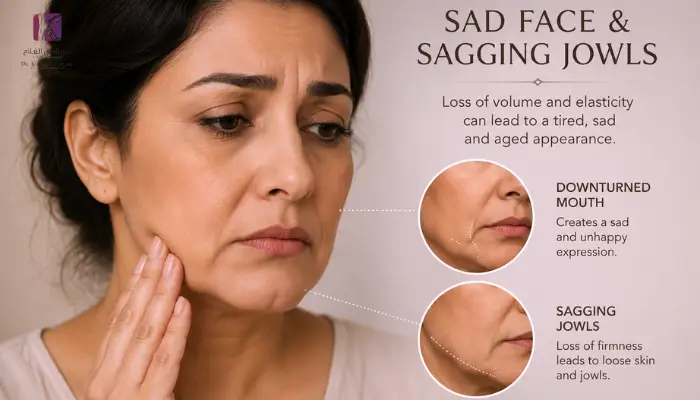
What actually causes a ‘sad face’ and sagging jowls?
Many people assume that sagging skin is simply a surface-level problem. In reality, facial ageing is a complex process that affects multiple layers of the face, from the underlying bone structure to the skin itself.
As we age, several things change at the same time:
- The facial bones gradually remodel and lose volume, reducing structural support.
- Fat pads that once provided youthful contours begin to shift downward.
- Collagen and elastin production declines, causing the skin to become thinner and less resilient.
- The skin loses firmness and elasticity, leading to laxity.
- Certain facial muscles become more dominant, pulling features downward over time.
Together, these changes can lead to jowls, a less defined jawline, flatter cheeks, and downturned corners of the mouth, creating a tired or sad appearance.
This matters because the cause determines the correct treatment. And Botox alone rarely addresses the root issue.
What does Botox actually do?
Botox (Botulinum Toxin Type A) is a purified protein that temporarily relaxes targeted facial muscles. It is best known for reducing dynamic wrinkles caused by repeated facial expressions.
Botox vs face treatments, where Botox excels:
- Forehead lines and horizontal creases
- Frown lines between the brows (glabellar lines)
- Crow’s feet around the eyes
- Bunny lines on the nose
- Lip lines when used very carefully
When comparing Botox vs face tightening, it’s important to understand that they treat different signs of ageing.
Botox works by relaxing the facial muscles responsible for expression lines. It does not tighten loose skin or lift sagging tissues.
One exception is treatment of the depressor anguli oris (DAO) muscle, which can subtly lift the corners of the mouth and reduce a sad-looking expression. However, this effect is modest and will not correct jowls or significant skin laxity.
Botox vs Face tightening: Understanding the difference
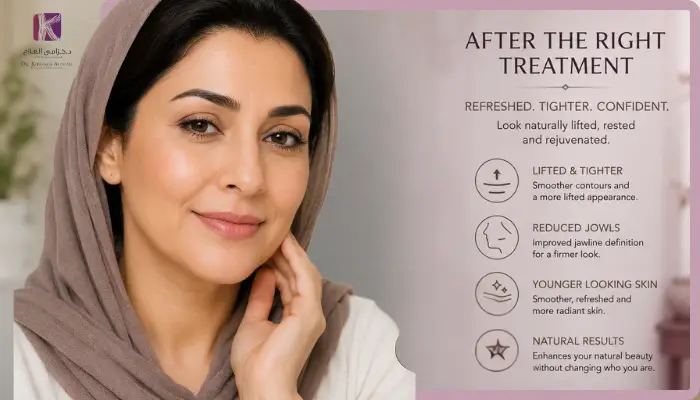
Face tightening treatments stimulate collagen production to improve skin firmness and can provide a mild lifting effect for loose skin. Unlike Botox, which relaxes facial muscles, they address the structural changes that develop with ageing.
| Botox vs Thread Lifts | One of the most common comparisons patients make is Botox vs thread lift. Thread lifts use dissolvable sutures placed beneath the skin to gently reposition sagging tissues while stimulating collagen production. They can improve mild to moderate jowls, jawline definition, and lower-face laxity. While Botox relaxes muscles, thread lifts physically support and elevate tissues, making them better suited for addressing facial sagging. |
| Botox vs Laser Treatments | When considering Botox vs laser treatment, the key difference lies in the treatment target.
Laser treatments, such as CO₂ fractional laser and Fraxel, use controlled heat to stimulate collagen production and renew the skin.
They can help improve:
|
| Radiofrequency (RF) and Ultherapy | Advanced skin-tightening treatments such as RF microneedling (including Morpheus8) and Ultherapy work at deeper tissue levels. These technologies stimulate collagen production within the dermis and the superficial musculoaponeurotic system (SMAS), the same foundational layer addressed during facelift surgery. For suitable candidates, they can provide meaningful tightening and contour improvement in the cheeks, jawline, and lower face without surgery. |
| Botox vs Plastic Surgery | For patients comparing Botox vs plastic surgery, it is important to recognise that these treatments occupy very different positions on the treatment spectrum. A surgical facelift remains the gold standard for correcting significant jowls, facial descent, and loose skin. It provides the most dramatic and longest-lasting results but involves surgery, recovery time, and greater associated risks. Non-surgical tightening procedures offer a middle ground between Botox and surgery for patients seeking improvement without undergoing an operation. |
Botox vs natural ageing: Is doing nothing better?
The question is whether Botox is necessary at all. The Botox vs natural ageing discussion ultimately comes down to personal preferences, priorities, and expectations.
What we do know is:
- Botox does not permanently alter facial anatomy. It temporarily relaxes targeted muscles to reduce the appearance of dynamic wrinkles.
- The results are temporary. Effects usually last around 3 to 6 months, after which repeat treatment may be needed to maintain the results.
- Ageing continues naturally. Over time, gradual collagen loss, skin laxity, and changes in facial volume continue to affect the appearance of the skin.
- Non-surgical tightening procedures take a different approach. Rather than temporarily relaxing muscles, some treatments support the body’s natural collagen production and may help improve skin firmness over time.
There is no universally right or wrong choice. Some people prefer to treat specific signs of ageing, while others are comfortable allowing their appearance to change naturally. Understanding the difference between Botox and natural ageing can help patients make an informed, unhurried decision based on their own preferences, goals, and expectations.
Why most patients need a combination approach?
In clinical practice, the debate between Botox vs face tightening is often not an either-or decision.
Facial ageing affects multiple layers of the face simultaneously, which is why many patients achieve the best outcomes through combination treatments.
A typical combination plan might include:
- Botox for the upper face to soften forehead lines, frown lines, and crow’s feet.
- A thread lift or Ultherapy for lower face and jowl lifting.
- Collagen stimulators (such as Sculptra or Radiesse) to restore lost facial volume.
- Fractional laser to improve skin quality and texture.
This comprehensive strategy, often referred to as a liquid facelift, addresses muscle movement, volume loss, skin laxity, and texture changes together, producing more balanced and natural-looking results.
Choosing the right treatment for your face
The answer to Botox vs face tightening depends entirely on the cause of your concerns.
Botox is highly effective for dynamic wrinkles and specific muscle-related issues, including downturned mouth corners caused by the DAO muscle. However, when sagging jowls, skin laxity, and loss of facial contour are the primary concerns, treatments such as thread lifts, laser resurfacing, RF microneedling, or Ultherapy are often more effective.
The most successful outcomes begin with an accurate assessment and a personalised treatment plan tailored to your unique facial anatomy, ageing pattern, and aesthetic goals.
Why choose Dr. Khuzama Al Falah for skin tightening in Riyadh?
Choosing the right specialist is just as important as choosing the right treatment. Dr. Khuzama Al Falah is a triple board-certified consultant dermatologist based in Riyadh, trained at McGill University in Montreal, Canada, with fellowships in Laser and Cosmetic Dermatology, Surgical Dermatology, and Contact Dermatitis.
With over 12 years of hands-on experience, she offers a full range of treatments to address facial ageing, including Botox, thread lifts, Ultherapy, RF microneedling, CO2 fractional laser, collagen stimulators, and more, all customised to the individual patient.
Her approach is known for:
- Natural-looking results that enhance rather than alter facial features.
- Personalised treatment plans based on detailed facial assessment.
- Conservative, patient-focused approach that prioritises long-term outcomes.
- Advanced technology and internationally recognised training.
- Commitment to evidence-based aesthetic medicine.
Whether you are exploring Botox vs face tightening, or looking for a trusted second opinion, Dr. Khuzama’s clinic in Riyadh offers a thoughtful, expert consultation to help you decide what is right for you.
FAQs
The questions patients ask in consultation
The Endolift procedure is performed under local anaesthesia. So, patients are comfortable and report a mild sensation of warmth or pressure.
The results after a well-performed internal laser facelift last between 2 and 3 years. Longevity depends on age, skin quality, lifestyle, and sun exposure.
Most patients achieve excellent results with a single Endolift session. In some cases, a second session may be recommended after three to six months.
Endolift is generally suitable for a wide range of skin types and tones. A thorough consultation and skin analysis is conducted before recommending any face lifting treatment to ensure the safest, most effective outcome.
What is the difference between Botox vs thread lift?
Botox relaxes specific facial muscles to soften expression lines. A thread lift uses dissolvable sutures to physically reposition tissue and stimulate collagen. They target different concerns and different tissue layers, which is why many patients benefit from both.
Is Botox vs laser treatment a common choice for the lower face?
They address different things. Botox reduces muscle activity; laser treatments improve skin quality and firmness by stimulating collagen. For the lower face, laser is often more useful for tightening, while Botox may be used carefully around the mouth or chin.
Is skin tightening better than Botox?
Neither treatment is better; they simply treat different concerns. Botox relaxes muscles to smooth expression wrinkles, while skin tightening uses energy or threads to fix loose, sagging skin.
What does Botox look like 20 years after?
Your skin will look significantly smoother with fewer deep wrinkles because the muscles have been trained not to creased the skin. If you stop, your face simply resumes ageing naturally from that point.
Is Botox vs natural ageing just a personal choice?
Largely, yes. Botox is not medically necessary, it is an elective cosmetic treatment. Some people prefer to age without intervention; others choose to treat specific concerns. Both are valid. What matters is making an informed decision based on accurate information rather than marketing.
Is 40 too late for Botox?
Not at all. While younger patients use it preventatively, starting at 40 effectively softens established lines and stops them from deepening further.
Can I choose a completely natural treatment instead of Botox?
If you prefer Botox vs natural remedies, skincare and facial massage can improve skin health, but they cannot relax the muscles that cause expression lines. Botox is more effective for softening these wrinkles.
Is Botox vs plastic surgery even a fair comparison?
Not really. Botox is a non-surgical treatment that softens wrinkles with little to no downtime, while a facelift addresses sagging skin and deeper structural changes through surgery.
Begin Your Graceful Lift Consultation
The clearest next step is a conversation, not a decision.
Send us a message on WhatsApp or book a private consultation. There is no obligation — you will leave with a plan, even if that plan is to wait.
- 60-minute clinical consultation with Dr. Khuzama personally
- Personalised treatment plan and transparent quotation
- Saudi-trained, internationally certified Consultant Dermatologist

Dr. Khuzama Al Falah
Saudi-trained, internationally certified Consultant Dermatologist practising in Riyadh. Dr. Khuzama is recognised for a deliberately conservative philosophy she calls Natural Elegance — an approach to aesthetic dermatology that prioritises restoring features over re-shaping them.
Her practice combines evidence-based dermatology with refined aesthetic judgement. She lectures internationally on minimally invasive lifting and is among the first cohort of certified Endolift practitioners in the Kingdom.
- Consultant Dermatologist
- Saudi Commission for Health Specialties
- Advanced Aesthetic Dermatology Fellowship
- Saudi Commission for Health Specialties
- Certified Practitioner
Meet the author
Every clinical claim has been written, reviewed and signed off by Dr. Khuzama. We do not host sponsored content. Treatment recommendations on this site reflect what we perform in clinic — nothing more, nothing less.
Continue reading
Related from the Journal
A curated selection of clinician-led reading — chosen for patients researching their lifting and skin-tightening options.