Botox, Fillers, Peels, or Mesotherapy? A Riyadh Dermatologist's Guide to Choosing the Right Treatment
Standing in front of the mirror and noticing new lines, dullness, or lost volume is one thing. Figuring out which treatment actually fixes it is another problem entirely.
Search “dermatologist in Riyadh”, and you’ll find dozens of clinics offering Botox, fillers, peels, and mesotherapy, often with overlapping promises and very little explanation of what each one is actually for. That confusion is the real starting point for most people who end up typing “best dermatologist in Riyadh” into Google at midnight.
This guide breaks down what each treatment does, who it’s genuinely suited for, and how a board-certified dermatologist decides between them. No sales pitch, just the information you need before you book a consultation.

In this article
The real pain points behind "Which treatment do I need?"
Before getting into the treatments themselves, it helps to name what’s actually frustrating about this decision, because you’re probably dealing with more than one of these at once.
You don’t know if your concern is a “wrinkle problem” or a “volume problem”
Fine lines that appear when you move your face (like frown lines or crow’s feet) come from muscle activity. Sagging cheeks or hollow under-eyes come from lost volume. These need completely different treatments, and it’s easy to ask for the wrong one.
You’re worried about looking “done”
The frozen, overfilled look you’ve seen on social media is almost always a result of overcorrection, not the treatment itself. Every legitimate dermatologist should be planning for subtlety, not maximum product volume.
Pigmentation and melasma add another layer of confusion
Dark patches, sun spots, and uneven tone are extremely common concerns in Riyadh’s climate, and they don’t respond to Botox or fillers at all. If your main issue is discoloration, peels or targeted pigmentation treatment are usually the starting point, not injectables
You’re not sure how much downtime to plan for
Some treatments need zero recovery time. Others need a week of careful sun avoidance. Not knowing this in advance can throw off travel plans, work schedules, or a big event.
You’re unsure whether the injector is actually qualified
Riyadh has a fast-growing aesthetics market, and not every clinic offering Botox or fillers is run by a board-certified dermatologist. This is arguably the biggest pain point of all, because the product matters far less than the hands administering it.
Keep these in mind as you read through each treatment below. Most people don’t need “a treatment.” They need the treatment that solves their specific version of these problems.
Botox: What it actually treats
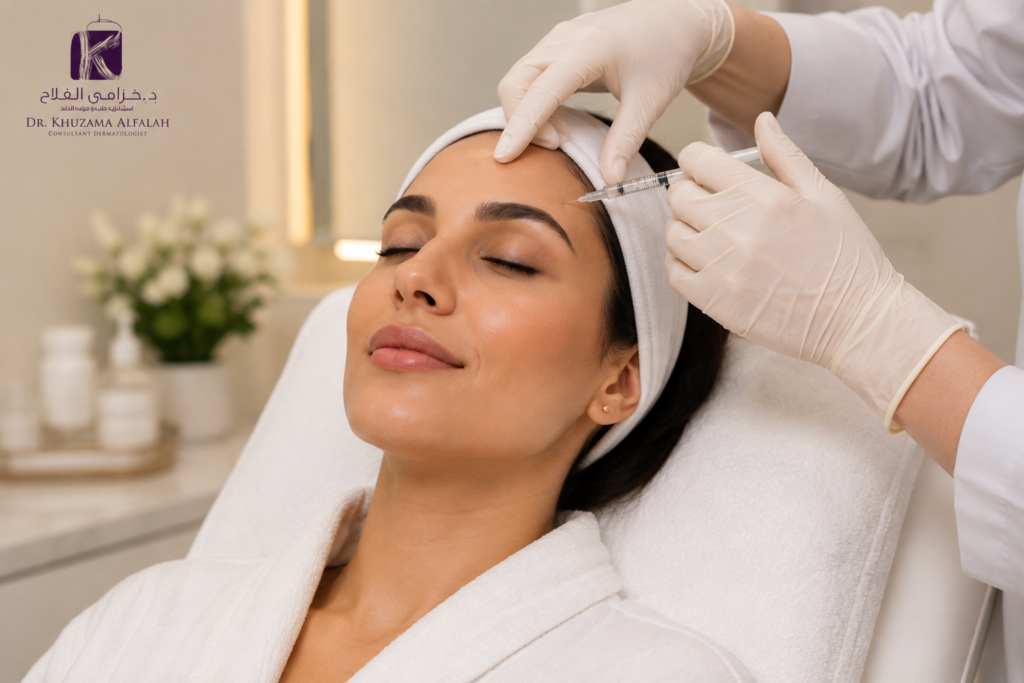
Botox (botulinum toxin) works on dynamic wrinkles, the lines that form when your facial muscles contract, like the ones between your brows when you frown or around your eyes when you smile. It’s a purified protein that temporarily relaxes the targeted muscle, so the overlying skin stays smoother even when you make expressions.
It doesn’t add volume. It doesn’t fix static lines that are visible even when your face is completely relaxed, and it won’t help with sagging skin. What it’s genuinely good at:
- Softening forehead lines, frown lines, and crow’s feet
- Preventing dynamic lines from deepening into permanent creases over time
- Treating excessive underarm, palm, or foot sweating (hyperhidrosis)
- Slimming a heavy jawline caused by an overactive masseter muscle
A session typically takes 15 to 30 minutes with almost no downtime. Initial changes appear within three to five days, with full results visible around the two-week mark, and effects generally last three to four months before muscle activity gradually returns.
One thing worth knowing: dosage isn’t one-size-fits-all. Forehead treatment might need anywhere from 10 to 30 units, depending on muscle strength, and an experienced injector adjusts this per patient rather than using a fixed formula.
Dermal Fillers: Restoring what time takes away
Where Botox relaxes muscle movement, fillers add structure. As skin ages, it gradually loses collagen, elastin, and the fat pads that once gave cheeks, temples, and the jawline their shape. Dermal fillers, most commonly made of hyaluronic acid, replace that lost volume and can also be used to refine contours that were never quite as defined as you wanted.
Fillers are generally grouped into two categories:
Hyaluronic acid fillers give immediate volume and hydration and gradually break down over time, typically lasting 9 to 18 months depending on the area and product.
Collagen-stimulating fillers, such as Sculptra, don’t add instant volume. Instead, they trigger your body to gradually produce its own collagen, with results that build over weeks to months and last up to two years.
Commonly treated areas include the cheeks and midface, jawline and chin, lips, under-eye hollows, and nasolabial folds (smile lines). A treatment session usually takes 30 to 45 minutes, with mild swelling or bruising that settles within a few days. Full results are visible once any initial swelling resolves, usually within one to two weeks.
The biggest risk with fillers isn’t the product itself, since hyaluronic acid fillers are reversible. It’s poor technique: incorrect depth or placement can create lumpiness, asymmetry, or an unnatural look that’s difficult to reverse gracefully.
Chemical Peels: Resetting your skin's surface
If your primary concern is texture, tone, or pigmentation rather than wrinkles or volume, a chemical peel is usually the more relevant option. A peel uses a controlled acid solution to remove damaged outer layers of skin, prompting new, healthier cells to take their place.
Peels are typically classified by depth:
Superficial | Mild dullness, minor discoloration, rough texture | Little to no |
Medium | Age spots, fine lines, moderate pigmentation | A few days of visible peeling |
Deep | Deep wrinkles, significant sun damage | A week or more |
Chemical peels are especially popular for treating melasma and hyperpigmentation, a common concern given the intensity of sun exposure in Riyadh. A single session can bring a noticeable glow within a week, but meaningful correction of acne scarring or stubborn pigmentation usually takes a series of three to six sessions spaced appropriately apart.
Because peeled skin is more sensitive to UV exposure, using sunscreen afterwards is mandatory. Skipping it can undo the results or even worsen pigmentation.
Mesotherapy and skin boosters: Hydration from within
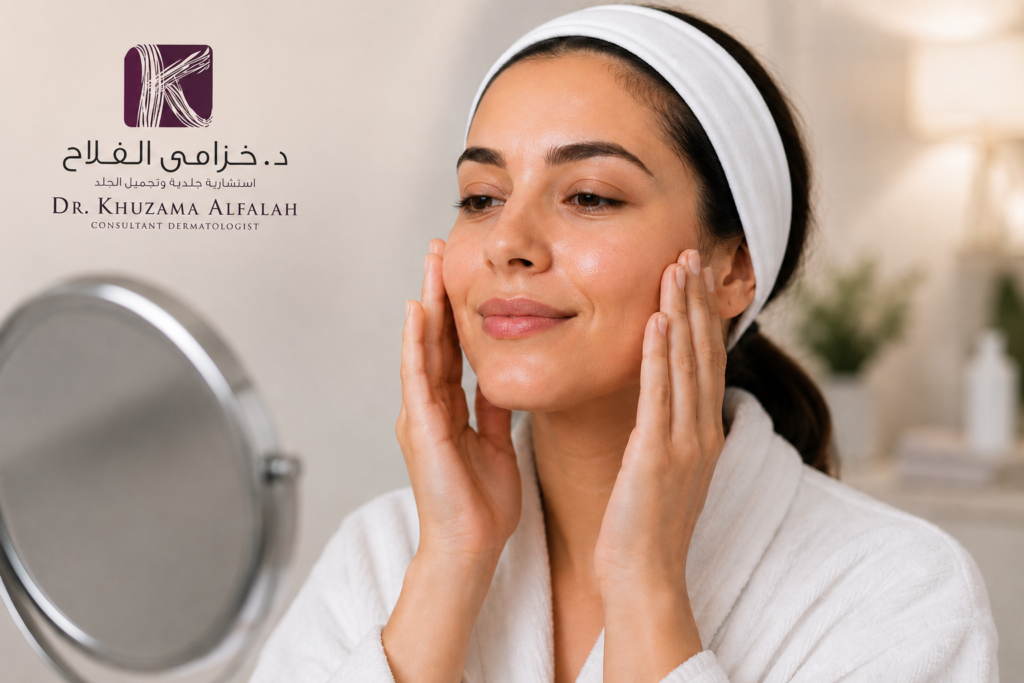
Mesotherapy and skin boosters solve a different problem altogether: skin that looks tired, dehydrated, or dull, even without obvious wrinkles or volume loss. Instead of relying on moisturizer sitting on the surface, these treatments deliver hyaluronic acid, vitamins, or bio-revitalizing compounds directly into the skin using a series of fine micro-injections.
They’re not designed to add volume or smooth deep lines. Their job is to improve the skin’s underlying quality, meaning better hydration, greater elasticity, and a healthier glow that shows up gradually.
Good candidates typically notice:
- Persistent dullness or dehydration that skincare products haven’t fixed
- Early, fine lines rather than deep wrinkles
- A desire for subtle improvement without changing facial shape
Most protocols involve two to three sessions, with small temporary bumps at injection sites that resolve within a day or two. Results build progressively, and maintenance sessions every several months help sustain the effect.
Side-by-side comparison table
Botox | Dynamic wrinkles, jaw slimming, and sweating | None to minimal | 3–4 months | Repeated every few months |
Dermal Fillers | Volume loss, contouring, hollows | A few days of mild swelling | 9–18 months (up to 2 years for Sculptra) | 1, with touch-ups over time |
Chemical Peels | Pigmentation, acne scars, texture | None to 1 week, depending on depth | 1–2 months (superficial) to years (deep) | 3–6 for significant correction |
Mesotherapy/Skin Boosters | Dehydration, dullness, skin quality | Minimal, small bumps for 24–48 hours | 6–9 months | 2–3 initially |
How to match a treatment to your actual concern
A simple way to think about it: ask what’s actually changed about your skin.
If lines only appear when you move your face, that’s a muscle issue, and Botox is the relevant starting point. If your face has lost its shape or fullness even at rest, that’s a volume issue, which points toward fillers. If the concern is really about color and texture, like dark spots, acne scarring, or an uneven tone, peels do the heavy lifting. And if your skin simply looks tired or dehydrated with no specific wrinkle or volume complaint, mesotherapy or skin boosters address the underlying skin quality.
Many patients don’t fit neatly into one category, and that’s completely normal. It’s common for a treatment plan to combine two or three approaches, for example, pairing a peel to address pigmentation with skin boosters to restore hydration, or combining Botox with fillers for comprehensive facial rejuvenation. This is exactly why a proper consultation matters more than picking a treatment off a website.
Why the practitioner matters more than the product?
It’s tempting to research brand names, like which filler line or which Botox formulation is “best.” In reality, the outcome depends far more on who is holding the needle than which product is in the syringe.
A dermatologist with deep training in facial anatomy understands exactly where muscles, vessels, and nerves sit beneath the skin. That knowledge is what prevents complications and produces results that look proportionate rather than overdone. Dr Khuzama Al Falah, a double board-certified dermatologist (Saudi Board and Arab Board of Dermatology) with triple fellowship training from McGill University, brings over 12 years of experience in cosmetic, laser, and surgical dermatology to every consultation at her Riyadh clinic.
That background matters because facial treatments aren’t interchangeable services. Getting the injection depth, dosage, and product selection right requires the kind of clinical judgment that comes from years of specialized training, not just familiarity with a device or syringe.
What to expect at your first consultation?
A proper first visit isn’t a quick sales conversation. It typically includes a review of your skin history and any previous treatments, a hands-on assessment of your specific concerns, and an honest conversation about which option, or combination of options, realistically fits your goals and budget. You should walk out with a clear plan, not just a booking for “whatever’s popular this month.”
If a clinic pushes you toward a specific product without first examining your skin, that’s a sign to look elsewhere.
Finding the treatment that fits your needs
FAQs
The questions patients ask in consultation
The Endolift procedure is performed under local anaesthesia. So, patients are comfortable and report a mild sensation of warmth or pressure.
The results after a well-performed internal laser facelift last between 2 and 3 years. Longevity depends on age, skin quality, lifestyle, and sun exposure.
Most patients achieve excellent results with a single Endolift session. In some cases, a second session may be recommended after three to six months.
Endolift is generally suitable for a wide range of skin types and tones. A thorough consultation and skin analysis is conducted before recommending any face lifting treatment to ensure the safest, most effective outcome.
Botox, fillers, peels, and mesotherapy aren’t competing treatments; they’re tools that solve different problems. The right choice comes down to what’s actually happening with your skin, not which treatment is trending. Dynamic wrinkles call for Botox. Volume loss calls for fillers. Pigmentation and texture call for peels. Dullness and dehydration call for mesotherapy or skin boosters. And often, a thoughtful combination of two or three gets you closer to your goal than any single treatment alone.
The most reliable way to figure out where you fall is to have a proper consultation with a qualified dermatologist who examines your skin before making any recommendations.
If you’re in Riyadh and trying to decide between these options, book a consultation with Dr Khuzama Al Falah for a personalised assessment based on your skin, not a generic treatment menu.
Can I combine Botox, fillers, peels, and mesotherapy into a single treatment plan?
Yes. Many patients benefit from a combination approach, for example, Botox for dynamic lines alongside fillers for volume, or a peel for pigmentation paired with skin boosters for hydration. A dermatologist will usually space out injectable treatments and peels across separate visits to allow proper healing.
Which treatment should I start with if I'm not sure what my skin needs?
Start with a consultation rather than a treatment. A dermatologist can assess whether your concern is muscle-related, volume-related, or texture-related and recommend treatment accordingly, rather than guessing.
Is Botox or filler better for someone in their late 20s or early 30s?
It depends on the concern. If you’re noticing early dynamic lines from expressions, preventative Botox is often recommended. If your concern is more about subtle volume loss or contouring, a conservative filler approach may be more appropriate. Most people in this age group don’t need aggressive treatment either way.
Are these treatments safe for all skin types?
Botox, fillers, and skin boosters are generally suitable for most skin types when properly assessed. Chemical peels require more individualized planning, since peel depth and acid type need to be matched carefully to your skin type to avoid irritation or uneven results.
How do I know if my dark spots need a peel or a different pigmentation treatment?
Chemical peels work well for many types of surface pigmentation and post-acne marks, but melasma and deeper pigmentation sometimes require a combination approach involving topical treatment, sun protection, and, in some cases, laser therapy. A dermatologist can determine the underlying cause before choosing the treatment path.
Begin Your Graceful Lift Consultation
The clearest next step is a conversation, not a decision.
Send us a message on WhatsApp or book a private consultation. There is no obligation — you will leave with a plan, even if that plan is to wait.
- 60-minute clinical consultation with Dr. Khuzama personally
- Personalised treatment plan and transparent quotation
- Saudi-trained, internationally certified Consultant Dermatologist

Dr. Khuzama Al Falah
Saudi-trained, internationally certified Consultant Dermatologist practising in Riyadh. Dr. Khuzama is recognised for a deliberately conservative philosophy she calls Natural Elegance — an approach to aesthetic dermatology that prioritises restoring features over re-shaping them.
Her practice combines evidence-based dermatology with refined aesthetic judgement. She lectures internationally on minimally invasive lifting and is among the first cohort of certified Endolift practitioners in the Kingdom.
- Consultant Dermatologist
- Saudi Commission for Health Specialties
- Advanced Aesthetic Dermatology Fellowship
- Saudi Commission for Health Specialties
- Certified Practitioner
Meet the author
Every clinical claim has been written, reviewed and signed off by Dr. Khuzama. We do not host sponsored content. Treatment recommendations on this site reflect what we perform in clinic — nothing more, nothing less.
Continue reading
Related from the Journal
A curated selection of clinician-led reading — chosen for patients researching their lifting and skin-tightening options.