SMAS-Deep: Decoding How XERF Targets Sagging Without Surgery
If your jawline feels a little less defined than it used to, or you’ve noticed some mild sagging along your neck, you’ve probably already searched for non-surgical ways to fix it. Somewhere in that search, you likely came across a term that sounds more like a tech gadget than a skincare treatment: XERF Skin Tightening.
Most publications ignore this part: drooping skin isn’t actually a “skin” condition. What happens one layer below, in a sheet of connective tissue known as the SMAS, determines whether your jawline seems defined or slack.
Surgeons have been targeting this same layer for decades, and it is what a facelift genuinely lifts. XERF’s claim to fame is its ability to reach the same depth without using a scalpel. This piece of blog explains how that’s intended to operate, what a realistic timeframe looks like, and how to choose the correct individual to do it.

In this article
What Is XERF Skin Tightening?
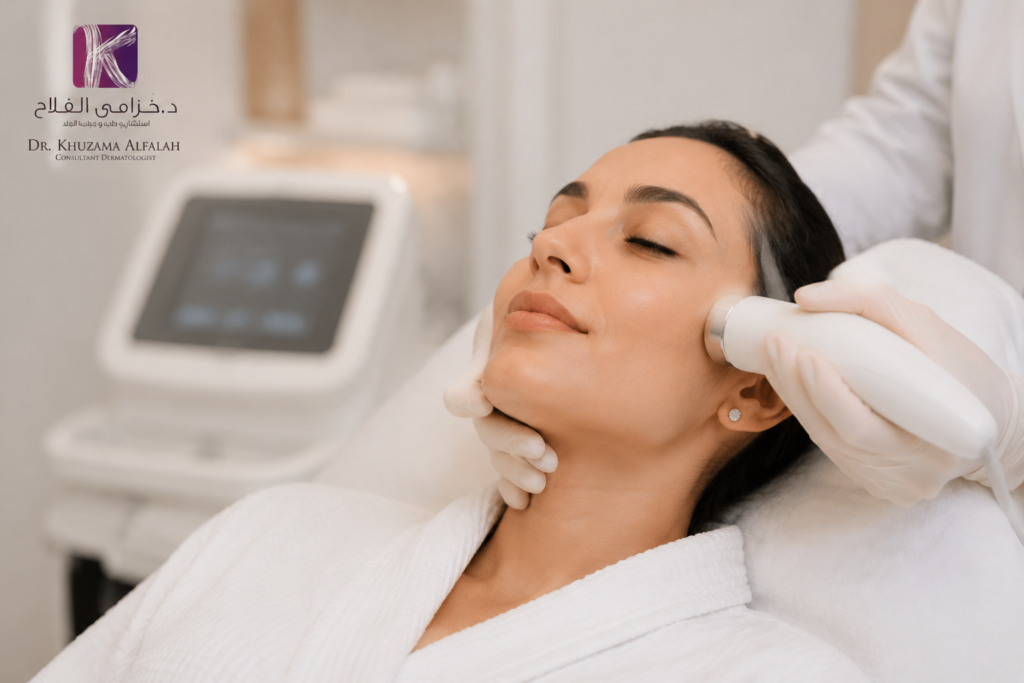
XERF is a non-surgical radiofrequency (RF) device that uses two different frequencies to heat skin tissue at more than one depth in the same session. Instead of relying on a single wavelength that mostly affects the surface, it’s built to reach both the mid-dermis and the deeper structural layers closer to the SMAS, the connective tissue that supports facial contour.
The purpose is not to remove skin or increase volume. It encourages your own collagen and elastin to regenerate, which is what naturally maintains your skin tight in your 20s but begins to slow down in your mid-30s. Consider it less of a rapid fix and more of a nudge to your skin’s repair system, which has ceased to function properly.
What Is the SMAS, and Why Does It Matter?
SMAS stands for the superficial musculoaponeurotic system, a fibrous, muscle-linked layer sitting beneath your skin and fat, wrapping around the face like a supportive sling. It’s what actually holds your jawline, cheeks, and neck contour in place. Skin sits on top of it; skin ages and gets treated on the surface, but sagging happens because this deeper sling loosens over time.
For this reason, a standard surgical facelift does more than just tighten the skin; it also elevates and re-secures the SMAS, repositioning the sling before cutting off extra skin. Additionally, no matter how effective they are, creams, peels, and surface-level lasers are unable to completely address genuine sagging since they never come into contact with this layer.
That’s the “decoding” part of XERF’s story. It isn’t marketed as reaching the SMAS by cutting it or repositioning it, but by heating tissue close to that plane so the body’s own collagen-remodeling response is triggered nearer to where structural support actually lives, not just at the skin’s surface.
How Does XERF Reach the SMAS Without Surgery?
RF energy works by converting an electrical current into heat as it moves through tissue. That heat does two things.
First, it can cause a small, immediate tightening effect, existing collagen fibers contract slightly when heated, a bit like how a rubber band shortens when warmed. Patients sometimes notice a subtle firmness right after a session.
Second, and more importantly, that controlled heat signals fibroblasts, the cells responsible for producing collagen, to get to work. This is a slower process. New collagen doesn’t appear overnight; it forms gradually over the following weeks, which is why the meaningful change from RF treatments is usually described as progressive rather than instant.
This is where the dual-frequency design of XERF is most important: a lower frequency (about 2 MHz) is intended to penetrate deeper, towards the subdermal fat and the SMAS itself, while a higher frequency (about 6.78 MHz) remains in the top and mid-dermis to promote texture and fine lines.
Instead of requiring several devices for surface issues versus subsurface laxity, a doctor manages the balance between the two within a single session. It’s important to be clear that this is heat stimulation close to the SMAS, not surgical relocation; the two methods use completely distinct mechanisms to affect the same structural layer.
Which Areas Does It Target?
XERF-style RF treatments are generally used on:
- Jawline and lower-face contour
- Neck and submental (under-chin) area
- Cheeks and mid-face
- Forehead
- Fine lines around the mouth and eyes
Here, too, Riyadh’s temperature and solar exposure are significant factors. For some individuals in the area, skin laxity may manifest faster than anticipated since dry air and UV exposure both speed up the breakdown of collagen.
Are You a Good Candidate?
RF skin tightening tends to suit people with mild-to-moderate laxity, think early jawline softening or a bit of looseness under the chin, rather than significant excess skin. If you’re in your early 30s to 50s and want a non-surgical option before considering (or instead of) a surgical facelift, it’s worth discussing at a consultation.
A licensed dermatologist needs to review your skin and medical history before confirming candidacy.
|
Likely a Good Fit |
May Need an Alternative |
|
Early 30s to 50s with mild-to-moderate laxity |
More advanced laxity or significant excess skin |
|
Wants a non-surgical, needle-free option |
Pregnant or breastfeeding |
|
No implanted electronic medical devices |
Has a pacemaker or similar implanted device |
|
No active skin infection in the treatment area |
Active infection or open wound in the treatment area |
|
Realistic expectations of gradual change |
Certain uncontrolled medical conditions (reviewed individually) |
What Actually Happens During a Session?
A typical appointment looks like this:
|
Step |
What Happens |
|
1. Assessment |
Your dermatologist examines your skin and talks through your goals — jawline definition, neck tightening, or overall firmness. |
|
2. Cleansing |
Skin is cleaned; numbing cream usually isn’t needed, since most patients describe the sensation as warmth rather than pain. |
|
3. Treatment |
The device is passed over the target area, delivering RF energy at a calibrated depth. A full-face session generally runs 30–45 minutes. |
|
4. Aftercare |
Most people leave with mild, temporary redness that settles within an hour, and no bandages or restrictions. |
Recovery: What to Expect Afterwards?
This is one of the bigger draws of RF skin tightening compared to more invasive options, there’s typically no real downtime. Most patients go straight back to work, can apply makeup once initial redness fades, and resume their normal skincare routine the same day. Daily sunscreen matters more than usual afterward, since freshly treated skin benefits from extra sun protection while it rebuilds collagen.
How Long Until You See Results - and How Long Do They Last?
This is usually the question people care about most, so here’s the honest version.
|
Timeframe |
What to Expect |
|
Weeks 1–4 |
Skin often looks unchanged on the surface, even though collagen remodeling has already started underneath. |
|
Weeks 4–12 |
Most people begin to notice small improvements in shape and firmer texture, especially around the neck and jawline. |
|
Optional second session |
Sometimes advised a few weeks after the first, especially with more noticeable laxity. |
|
~12 months |
Although this varies depending on age, baseline skin health, sun habits, and lifestyle, many patients report sustaining noticeable improvement up to this point. |
|
Maintenance |
An annual session is commonly discussed as a way to extend results rather than starting over each time. |
FAQs
The questions patients ask in consultation
Does XERF skin tightening really work?
Dual-frequency radiofrequency treatments, such as XERF, are usually seen to be successful in promoting the skin’s natural collagen formation for mild-to-moderate skin laxity, which can result in a firmer texture over a few weeks. A realistic expectation is a firmer, rejuvenated version of your own skin rather than a surgical-level lift because results are gradual and incremental rather than dramatic or instantaneous, and they depend on your baseline skin condition
How long does XERF skin tightening last?
Many patients report visible benefit for around 12 months, though this varies based on age, sun exposure, and lifestyle. An annual maintenance session is commonly discussed as a way to extend results.
Does XERF tighten neck skin?
Indeed, as this is frequently where early laxity initially appears, the neck and under-chin region are among the most frequently treated areas for RF skin tightening. During a consultation, a doctor will determine whether RF alone is a good fit for your particular neck issue or if a combo treatment makes more sense.
What is XERF treatment for skin?
This non-surgical, needle-free radiofrequency therapy, which is mostly used for mild-to-moderate face and neck skin laxity, heats tissue at many depths to promote spontaneous collagen remodeling.
Is there any downtime after RF skin tightening?
Generally very little. Most patients experience only mild, temporary redness or warmth that resolves within an hour, with no restrictions on returning to normal activities the same day.
XERF Compared to a Surgical Facelift and Other RF Treatments
Since XERF’s whole premise is reaching the SMAS without surgery, the most useful comparison isn’t another RF device, it’s the surgical facelift itself. A facelift physically repositions and re-secures the SMAS, then removes excess skin over it, which is why it remains the more definitive option for significant or advanced sagging. XERF, by contrast, doesn’t reposition anything; it heats tissue near that layer to encourage new collagen, which is why it’s positioned for milder, earlier laxity rather than as a facelift replacement.
|
Feature |
Surgical Facelift |
XERF (Non-Surgical RF) |
|
Approach to the SMAS |
Physically lifts and re-secures it |
Heats tissue near it to stimulate collagen |
|
Suited for |
Moderate to advanced sagging, excess skin |
Mild-to-moderate laxity, early sagging |
|
Anesthesia |
General or deep sedation |
None; no numbing typically needed |
|
Downtime |
Weeks |
Minimal to none |
|
Result onset |
Immediate |
Gradual, over 4–12 weeks |
|
Reversibility of the procedure itself |
Permanent structural change |
No structural change; effect fades over time |
Within the non-surgical category, XERF’s main distinction from many single-frequency RF devices is its ability to treat superficial and deeper layers in one pass. Compared with RF microneedling devices (like Morpheus8), it doesn’t use needles, which means less downtime but also a different depth-control mechanism, needling allows more precise targeting at the cost of a few days of redness and swelling.
Compared with HIFU-based devices like Ultherapy, RF tends to feel more like gentle warmth, while HIFU can involve brief, sharper sensations at focal points. None of these is universally “better”, the right choice depends on your skin, your goals, and what your dermatologist recommends after an in-person exam.
|
Feature |
XERF (Dual-Frequency RF) |
RF Microneedling (e.g., Morpheus8) |
HIFU (e.g., Ultherapy) |
|
Needles required |
No |
Yes |
No |
|
Numbing typically needed |
Generally no |
Yes |
Sometimes |
|
Downtime |
Minimal to none |
Redness/swelling for a few days |
Minimal |
|
Depth control |
Broad, multi-depth heating |
Precise, needle-delivered depth |
Focused ultrasound to deeper layers |
|
Best suited for |
Mild-to-moderate laxity, needle-free preference |
Texture, scarring, more aggressive remodeling |
Deeper structural lifting |
Choosing the Right Clinic in Riyadh
Here’s something worth knowing before you book anything: RF skin tightening is a medical procedure, not a spa treatment, even though it’s marketed casually online. Energy-based devices can cause burns or uneven results if the settings aren’t matched correctly to your skin type, which is exactly why it matters whether the person holding the handpiece is a board-certified dermatologist or a technician following a generic protocol.
Dr. Khuzama Al Falah’s Riyadh clinic is built around that distinction. As a triple board-certified dermatologist trained at McGill University in laser and cosmetic dermatology, she assesses candidacy individually before recommending an RF-based option, including ATTIVA internal radiofrequency skin contouring, one of the RF technologies available at her clinic for patients exploring non-surgical tightening.
If you’re comparing XERF against other RF systems, a consultation is the place to get a straight answer on which technology fits your skin, rather than guessing from online spec sheets.
Looking for Non-Invasive Ways to Fix that Sagging?
Choose the SMAS XERF Technique with Dr. Khuzama
Sagging isn’t just a surface problem; it’s a SMAS problem, and that’s the layer XERF is designed to influence without surgery.
Although it operates through a fundamentally different mechanism than a surgical lift, its dual-frequency technique heats tissue at numerous levels to encourage collagen renewal near that structural layer, making it a meaningful choice for early-to-moderate laxity.
A consultation with a board-certified dermatologist like Dr. Khuzama Al Falah is the most dependable way to determine whether XERF, ATTIVA, or another RF-based methodor, in the case of more severe sagging, a surgical referral, is the best option for tightening your skin if you’re in Riyadh.
Begin Your Graceful Lift Consultation
The clearest next step is a conversation, not a decision.
Send us a message on WhatsApp or book a private consultation. There is no obligation — you will leave with a plan, even if that plan is to wait.
- 60-minute clinical consultation with Dr. Khuzama personally
- Personalised treatment plan and transparent quotation
- Saudi-trained, internationally certified Consultant Dermatologist

Dr. Khuzama Al Falah
Saudi-trained, internationally certified Consultant Dermatologist practising in Riyadh. Dr. Khuzama is recognised for a deliberately conservative philosophy she calls Natural Elegance — an approach to aesthetic dermatology that prioritises restoring features over re-shaping them.
Her practice combines evidence-based dermatology with refined aesthetic judgement. She lectures internationally on minimally invasive lifting and is among the first cohort of certified Endolift practitioners in the Kingdom.
- Consultant Dermatologist
- Saudi Commission for Health Specialties
- Advanced Aesthetic Dermatology Fellowship
- Saudi Commission for Health Specialties
- Certified Practitioner
Meet the author
Every clinical claim has been written, reviewed and signed off by Dr. Khuzama. We do not host sponsored content. Treatment recommendations on this site reflect what we perform in clinic — nothing more, nothing less.
Continue reading
Related from the Journal
A curated selection of clinician-led reading — chosen for patients researching their lifting and skin-tightening options.