anti-wrinkle injections
How Long Does Botox Last?
A Guide to Results, Maintenance and Timing
You’re thinking about Botox. Maybe you’ve already done it once, or you’re still sitting on the fence. Either way, there’s one thing bouncing around in your head: How long does Botox last? It’s the question I hear most, and it deserves more than a generic answer.

The Question Everyone Asks (And Never Gets a Straight Answer)
And I get it. You’re not just asking about timelines. What you’re really wondering is: Will this be worth my time? Will I need to keep coming back forever? Can I actually afford to do this?
These aren’t silly questions. They’re exactly the ones I hear from people like you every single day in my clinic in Riyadh. And honestly, they deserve a real answer, not some generic response that sidesteps the nuance.
So here’s what you need to know, straight up: Botox isn’t permanent. It doesn’t last forever. But that doesn’t mean it’s not worth doing. The key is understanding the realistic timeline, what affects how long your results stick around, and how to get the most from each treatment.
The Basic Timeline: What to Actually Expect?
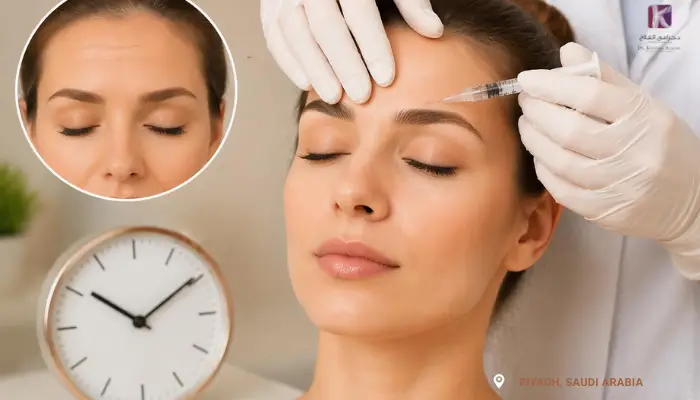
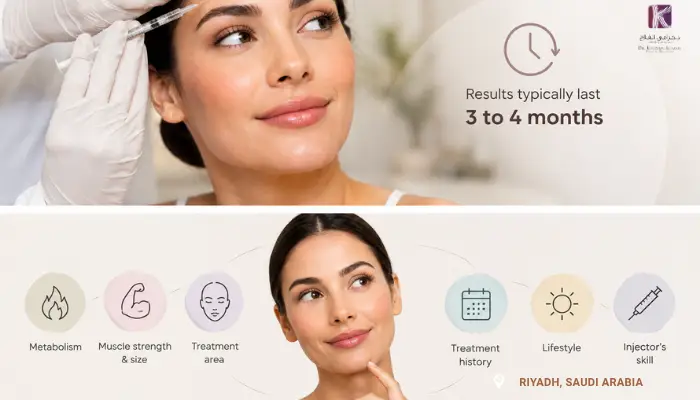
Most people see Botox results last between 3 to 4 months – here’s your short answer. However, some people stretch it closer to 5 or 6 months, especially if they’ve had consistent treatments over time. A smaller percentage notice movement coming back around the 2-month mark.
But here’s where most articles lose you: they act like that 3–4 month range applies to everyone equally. It doesn’t.
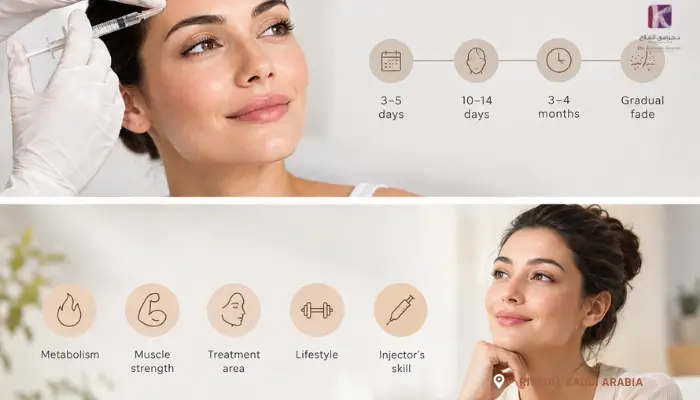
The journey starts the moment the needle goes in. On day 3 to 5, you’ll start to notice subtle changes. Your forehead might feel a bit smoother. That frown line between your eyebrows? It’s getting softer. But this is just the beginning. True results – the ones that really make you go “wow” – usually show up by day 10 to 14. Your skin looks refreshed. The dynamic wrinkles from your expressions have softened significantly. You look like yourself, just… rested.
From there, those results stay pretty consistent for another 2 to 3 months. Then, gradually – and this is important – the effects don’t suddenly vanish. They fade. Your muscles slowly regain their movement. The wrinkles you had before don’t come roaring back overnight. They creep back in gradually over 2–4 weeks after that 3–4 month mark.
Why Your Timeline Might Be Different Than Your Friend's?
This is where it gets interesting. You probably know someone who says their Botox lasts six months. Or maybe you have a friend who swears she needs to come back every 10 weeks. Both of them could be telling you the truth.
Metabolism: Your Body's Speed Setting
Metabolism acts as your body’s engine. People with faster metabolism burn through everything quickly, including Botox. For example, if you’re a person who exercises a lot, eats well, or has a naturally high metabolic rate, your body will also break down the Botox protein faster than average. It doesn’t mean something is wrong with you; your biology simply works differently.
On the flip side, if your metabolism is slower, Botox might stick around longer.
Muscle Strength and Size
Not all facial muscles are created equal. The bigger, stronger your facial muscles, the more they want to move. The muscles in your forehead are typically larger and more active than the smaller muscles around your eyes. This is why Botox results vary by area of the face – some zones hold results longer than others.
If you have naturally strong facial expressions (the kind where you furrow your brow deeply when concentrating, or scrunch your eyes when you smile), your muscles are more robust. Botox will still work, but it has to work harder, which can mean results fade a bit sooner.
Treatment Area Matters More Than You Think
- Your crow’s feet? Those tiny muscles usually hold Botox for 4–5 months.
- Your forehead lines? Often closer to 3 months because of all that movement.
- Your frown lines between your eyebrows – the glabellar lines – sit somewhere in the middle.
Does Botox last longer in certain areas of the face? Absolutely. Areas with smaller, less active muscles tend to hold results significantly longer than high-movement zones.
Your Treatment History
This one surprises people, but it’s real: Does Botox last longer with repeated treatments? For many people, yes.
Here’s the mechanism: when you get Botox consistently over time, your muscles become conditioned. They relax more easily. Some patients who’ve been getting treatments for years find they can stretch the interval between appointments from 3–4 months to 4–5 months, or even longer. Your muscles literally “learn” to relax.
But I need to be honest about something: the first time you get Botox, it often wears off a bit faster. Botox results for first-time users typically stick around for 2.5 to 3 months rather than the full 4. This is completely normal and doesn’t mean anything went wrong.
Lifestyle: The Hidden Factor
Most people are unaware of this hidden factor: your daily habits affect Botox duration.
Intense exercise, especially weight training and high-impact cardio, increases your heart rate and metabolism. More blood flow means faster breakdown of the Botox protein. If you’re an athlete or someone who hits the gym hard 5+ days a week, you might see results fade sooner than someone with a more moderate exercise routine. This doesn’t mean you should stop exercising – your health matters more than Botox longevity. But it’s worth knowing.
Sun exposure is another significant factor, as UV radiation accelerates the breakdown of the Botox protein. If you spend hours in the sun without proper sun protection, you’re essentially speeding up the fading process.
The Injector's Skill (This One's Critical)
If you’ve had one person do your Botox and got 6 months of results, then switched providers and barely got 3 months, this is probably why.
An experienced injector knows where to place the product for optimal diffusion. They understand muscle anatomy well enough to know the exact dosage for your specific muscle strength. They know how to place it deep enough that it lasts, but superficially enough that it looks natural. A less experienced injector might place it too superficially (where it breaks down faster) or in the wrong spot altogether.
This isn’t meant to scare you. It just means your choice of provider matters more than people realise.
The Real Cost of Time: How Often Do You Actually Need to Return?
Let’s talk about the maintenance side of this equation, because this is where people start doing the maths in their heads.
How often should you get Botox injections? Usually every 3 to 4 months – it’s the standard recommendation. Most of my patients aim for the 3-month mark to avoid visible fading. A few wait until month 4 if they’re okay with a bit of movement coming back.
Here’s a quick pattern to remember: if you come in at month 3, you’re just refreshing your results while they’re still strong, and your cumulative smoothness stays consistent.
On the other hand, if you wait for 4 or 5 months, it’s a ‘bigger’ reset each time, going from noticeably more movement back to smooth again.
Both strategies work; it’s about your preferences and budget.
Some people ask me: Can you get Botox too often? The short answer is no, not in the way you might be thinking. You shouldn’t get Botox before 3 months have passed because your muscles need time to regain their ability to move again. Getting injected too frequently (before the previous dose has worn off) doesn’t create better results; it just increases cost and the risk of antibody formation (where your body essentially becomes resistant to Botox). But coming back every 3–4 months is absolutely safe to do indefinitely.
When Botox Wears Off: What Actually Happens
I think there’s a lot of fear around this part, so let me demystify it.
What happens when Botox wears off? Your muscles gradually regain their ability to contract. That frown line you’ve smoothed out? It starts to reappear, not suddenly, but gradually over a couple of weeks. Your crow’s feet come back. Your forehead lines return.
But here’s what doesn’t happen: you don’t wake up looking worse than before. Your skin doesn’t age faster as a punishment for using Botox. The wrinkles that come back are the same ones that were there before your first treatment. You’re not starting from a worse baseline.
In fact, some people find that having regular Botox actually slows down the formation of deeper wrinkles over time, since you’re preventing the repeated muscle contraction that etches lines into your skin. But that’s a long-term benefit, not a guarantee.
How to Make Botox Last Longer: The Science-Backed Strategies
When you invest in Botox, you probably want the maximum result from each appointment. Fair enough. Try some of these strategies to maintain your results.
1. Sun Protection Is Essential
Sun protection doesn’t just help with Botox longevity; it’s for your skin, period.
- Daily sunscreen (SPF 30 minimum, SPF 50+ is better) with broad-spectrum protection
- Avoid peak sun hours when possible
- Wear hats if you’re going to be outside for extended periods
In Riyadh, with the intense sun year-round, this is genuinely critical. UV protection helps preserve your Botox results and keeps your skin in better overall condition.
2. Avoid Heavy Exercise Immediately Following Treatment
Avoid exercise for the 24–48 hours following your Botox treatment. Increased blood flow and higher heart rates may facilitate the absorption of Botox. I advise my patients to be gentle for a few days, after which they can resume their normal routines.
3. Stick to Medical-Grade Skincare Routines
Sunscreen (already discussed), and a strong retinoid cream at night. Retinoids stimulate collagen production and maintain smooth skin texture. Using a medical-grade Vitamin C serum in the morning can improve the quality of the skin. These are not alternatives to Botox but complementary to it, intended to keep your skin as healthy as you can.
4. Stay Consistent with Treatment Timing
How often should I get Botox to maintain results? If you want the best outcomes, consistency matters. Coming in every 3–4 months, like clockwork, conditions your muscles and often results in longer-lasting effects than sporadic treatment.
If you come in at month 1, skip 5 months, then come back, you’re basically starting over each time. Your muscles don’t have that cumulative conditioning.
5. Manage High-Impact Exercise (If Relevant)
If you’re a serious athlete or intense exerciser, be aware that your results might naturally fade faster. You can still have Botox; just set your expectations accordingly. You might need touch-ups every 3 months instead of 4. That’s not a problem; it’s just your biological reality.
Botox Maintenance Schedule: Creating Your Personal Timeline
Here’s where you get practical. Let me walk you through how to think about your Botox maintenance schedule and timing:
Month 0 (Initial Treatment): You come in and get your first Botox. Results start showing by day 3–5, with full results by day 10–14.
Months 1–2: You’re in the sweet spot. Results are strong and consistent.
Month 3: This is usually when people start noticing slight softening. For many, this is the perfect refresh point – you’re refreshing while results are still good.
Month 3.5–4: Results are definitely starting to fade. Movement is coming back. If you didn’t refresh at month 3, now’s the time.
Month 4+: You’re back to baseline. The lines are returning. If you haven’t come back yet, schedule now.
Some people like to come in at month 3 consistently. Others prefer to wait until they see results fading. There’s no “right” answer – it depends on your budget, your tolerance for seeing wrinkles reappear, and your personal preferences.
First-Time Botox: Setting Realistic Expectations
If you’re on the fence about trying Botox for the first time, let me address what you might actually experience.
Your results will likely be beautiful, but they might fade a bit sooner than 3–4 months. How soon will I see Botox results? Results start showing within 3–5 days, but it varies, with full results by day 10–14. And regarding duration: first-timers often get about 2.5–3 months instead of the full 4 months.
This is completely normal. It doesn’t mean the treatment failed or that you’re a “bad candidate.” It’s just how your body responds the first time.
The good news: second and third treatments often last longer as your muscles adjust. Many patients find they hit their longest duration by their 3rd or 4th treatment.
Is Botox Worth the Time Investment?
Here’s my honest take: Botox isn’t permanent, and it does require maintenance. If you’re looking for a one-time treatment that lasts forever, Botox isn’t it.
If you want to see a visible improvement in your appearance for 3–4 months at a time with little downtime and no surgery, and you don’t mind returning a few times a year, then yes, it’s definitely worth considering.
The Botox treatment timeline gives you a window of confidence. You look refreshed. You feel good about your appearance. Then, gradually, that fades. If you want to maintain it, you come back.
It’s not high-maintenance, but it’s not no-maintenance either. You’re choosing to be proactive about how you look, and that requires showing up every few months.
The question is not whether Botox is worth it; it’s whether you think it’s worth it. And the only way to know is to understand exactly what you are signing up for. No surprises. No unrealistic expectations. Just honest, straightforward facts on how long Botox lasts, why your timeline may be different from another person’s, and how you can get the absolute most from your Botox treatments.
Still comparing options? Read our guides on Botox, fillers, peels or mesotherapy and Botox vs face tightening.
Get Personalised Guidance on Your Botox Journey
I’ve been doing this for more than a decade and can assure you: Botox is effective. The results are real, they’re noticeable, and they’re possible for almost anyone willing to commit to them.
However, the magic lies not in the Botox but in the application. To get consistent results, it’s all about knowing your body, establishing realistic goals, and committing to maintenance.
That’s the kind of conversation I love to have – whether you’re curious if Botox is right for you, whether you’re a good candidate, what your timeline might look like, or how you can get the best results out of Botox.
You don’t need to make this decision blindly. Book a consultation and let’s discuss your goals, your skin, your face and your situation – what a realistic Botox journey might look like for you. Not for someone you follow on Instagram, but for you and your face.
Because ultimately, that’s what matters. Not the average timeline. Your timeline.
FAQs
The questions patients ask in consultation
Most people can expect results to last between 3 and 4 months. Some may last up to 5–6 months, particularly after regular previous treatments. For first-timers, it will usually be around 2.5 to 3 months.
It depends on metabolism, the strength of the muscles involved, exercise intensity, sun exposure, lifestyle and the skill of the injector. Your genetics and lifestyle have a big impact.
Getting injected before month 3 isn’t recommended because your muscles need recovery time, and too-frequent injections can increase the risk of antibody formation. But treatment every 3–4 months indefinitely is safe.
Your muscles gradually regain movement. Wrinkles reappear gradually over a couple of weeks – not suddenly, and not worse than before. Your skin doesn’t “age faster” as compensation.
For many people, yes. Your muscles become conditioned, and regular patients often find results extending to 4–5 months or longer after several years of consistent treatment.
Use sun protection (SPF 50+), avoid strenuous exercise for 48 hours after treatment, use medical-grade skincare containing retinoids, keep treatment timing consistent at every 3–4 months, and manage high-impact exercise habits.
Book regular visits every 3–4 months. This conditions your muscles and generally gives a longer-lasting effect than intermittent treatment. Most people opt for refresh appointments at month 3.
How long do Botox results typically last?
Most people can expect results to last between 3 and 4 months. Some may last up to 5–6 months, particularly after regular previous treatments. For first-timers, it will usually be around 2.5 to 3 months.
Why does Botox fade faster in some people?
It depends on metabolism, the strength of the muscles involved, exercise intensity, sun exposure, lifestyle and the skill of the injector. Your genetics and lifestyle have a big impact.
Can you get Botox too often?
Getting injected before month 3 isn’t recommended because your muscles need recovery time, and too-frequent injections can increase the risk of antibody formation. But treatment every 3–4 months indefinitely is safe.
What happens when Botox wears off?
Your muscles gradually regain movement. Wrinkles reappear gradually over a couple of weeks – not suddenly, and not worse than before. Your skin doesn’t “age faster” as compensation.
Does Botox last longer with repeated treatments?
For many people, yes. Your muscles become conditioned, and regular patients often find results extending to 4–5 months or longer after several years of consistent treatment.
How can I make Botox last longer?
Use sun protection (SPF 50+), avoid strenuous exercise for 48 hours after treatment, use medical-grade skincare containing retinoids, keep treatment timing consistent at every 3–4 months, and manage high-impact exercise habits.
What's the best Botox maintenance plan?
Book regular visits every 3–4 months. This conditions your muscles and generally gives a longer-lasting effect than intermittent treatment. Most people opt for refresh appointments at month 3.
Begin Your Graceful Lift Consultation
The clearest next step is a conversation, not a decision.
Send us a message on WhatsApp or book a private consultation. There is no obligation — you will leave with a plan, even if that plan is to wait.
- 60-minute clinical consultation with Dr. Khuzama personally
- Personalised treatment plan and transparent quotation
- Saudi-trained, internationally certified Consultant Dermatologist

Dr. Khuzama Al Falah
Saudi-trained, internationally certified Consultant Dermatologist practising in Riyadh. Dr. Khuzama is recognised for a deliberately conservative philosophy she calls Natural Elegance — an approach to aesthetic dermatology that prioritises restoring features over re-shaping them.
Her practice combines evidence-based dermatology with refined aesthetic judgement. She lectures internationally on minimally invasive lifting and is among the first cohort of certified Endolift practitioners in the Kingdom.
- Consultant Dermatologist
- Saudi Commission for Health Specialties
- Advanced Aesthetic Dermatology Fellowship
- Saudi Commission for Health Specialties
- Certified Practitioner
Meet the author
Every clinical claim has been written, reviewed and signed off by Dr. Khuzama. We do not host sponsored content. Treatment recommendations on this site reflect what we perform in clinic — nothing more, nothing less.
Continue reading
Related from the Journal
A curated selection of clinician-led reading — chosen for patients researching their lifting and skin-tightening options.